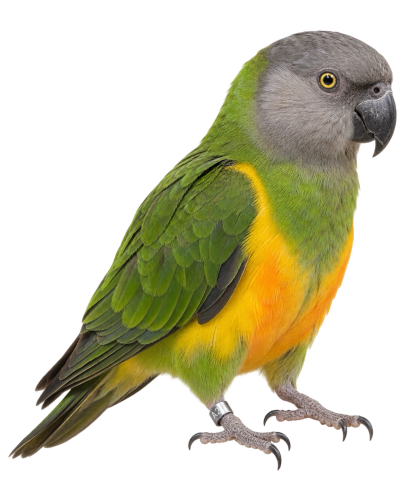
Senegal Parrot
Adult Senegal Parrot – Approximately 6 Years Old & Not Tame
Senegal Parrot Care Guide
Adult Senegal Parrot – Approximately 6 Years Old & Not Yet Tame
Scientific name: Poicephalus senegalus
Adult size: Approximately 23 cm (9 inches)
Typical weight: Around 125–170 g
Lifespan: Commonly 25–30+ years, with some individuals living considerably longer with excellent care.
A 6-year-old Senegal parrot is still a relatively young adult and potentially has many years ahead of him. Senegal parrots are intelligent, inquisitive birds that can form very strong relationships with the people they learn to trust.
An adult bird that is currently untamed should not be expected to behave like a hand-reared youngster immediately. Depending on his previous upbringing and experiences, gaining his confidence may take days, weeks or several months.
Patience and consistency are far more effective than forcing interaction.
PERSONALITY & TEMPERAMENT
Senegal parrots are members of the Poicephalus family and are generally considered relatively quiet parrots compared with many larger species.
They are intelligent, playful and capable of forming extremely strong relationships with their owners.
Individual personalities vary considerably. A Senegal may be:
- Confident and inquisitive
- Initially nervous around new people
- Independent
- Playful
- Territorial around its cage
- Strongly attached to one particular person
- Occasionally nippy when frightened, overexcited or defending its space
An untamed Senegal should never automatically be labelled aggressive because it attempts to bite.
Biting is often communication.
The bird may simply be saying:
“I'm frightened.”
“You're too close.”
“I'm not ready.”
“Please leave me alone.”
Learning to recognise and respect these signals is an important part of gaining the bird's trust.
THE FIRST FEW WEEKS
Moving to a new home can be stressful for an adult parrot.
Initially, concentrate on allowing your Senegal to become comfortable with:
- His new cage
- The room
- Household noises
- Your voice
- Your normal routine
- People walking past
- The location of his food and water
Do not immediately attempt to catch or handle him.
Place the cage somewhere the parrot can see normal household activity without being in the busiest or most chaotic part of the home.
Having part of the cage against a wall can help a nervous bird feel more secure because he cannot be approached from every direction.
Spend time nearby without demanding interaction.
Talk gently while changing food and water, cleaning the cage or simply sitting nearby.
The first objective isn't:
“Get him onto my hand.”
It is:
“Teach him that I'm safe.”
TAMING & BUILDING TRUST
At six years old, there is absolutely no reason why a Senegal cannot become much tamer.
However, allow the bird to determine the speed of progress.
Stage 1 – Become a Safe Presence
Sit close enough that the bird notices you but remains reasonably relaxed.
Talk normally and calmly.
Avoid:
- Staring directly at him for long periods
- Sudden movements
- Chasing him around the cage
- Putting your hands into his personal space unnecessarily
- Trying to stroke him before he is ready
- Grabbing him
You want your presence to predict good things rather than confrontation.
Stage 2 – Find His Favourite Treat
Find something the bird particularly enjoys.
This might be:
- A small piece of walnut
- Almond
- Pumpkin seed
- Sunflower seed
- Pine nut
- A favourite fruit or vegetable
High-fat nuts and seeds should only be used in small quantities.
Initially, simply place the treat into his bowl while he watches.
Eventually offer it through the cage bars.
Don't chase him around with it.
Hold the treat still and allow him to make the decision to approach you.
Even coming slightly closer should be considered progress.
Stage 3 – Taking Food From Your Hand
Once the bird comfortably approaches for treats through the cage bars, start encouraging him to take food directly from your fingers.
Keep sessions short.
Approximately 5–10 minutes at a time is plenty.
Several short, positive sessions are generally better than one long stressful session.
If he refuses, moves backwards or becomes frightened, finish the session positively and try again later.
Never punish a parrot for refusing.
Stage 4 – Target Training
Target training can be particularly useful with an adult untamed parrot.
A simple target such as a chopstick can be presented near the bird.
Reward him when he calmly investigates or touches the end.
Gradually, the target can be used to encourage the bird to move:
- Along a perch
- Towards the cage door
- Onto another perch
- Eventually towards you
This allows training without immediately asking the bird to accept hands.
Stage 5 – Step Up Onto a Perch
For a nervous adult Senegal, asking him to step directly onto a hand may initially be too much.
A handheld perch can be an excellent halfway stage.
Teach the command:
“Step up.”
Present the perch calmly and reward the bird when he steps onto it.
Once he reliably steps onto a perch, you can gradually begin introducing your hand.
Stage 6 – Stepping Onto Your Hand
Only begin this once the bird is comfortable being close to your hands.
Don't repeatedly push your hand into his chest.
Offer your hand steadily and give the verbal cue:
“Step up.”
Reward successful attempts immediately.
If he clearly refuses, don't turn the interaction into a battle.
Try again later.
BITING
Senegal parrots have powerful beaks for their size.
Learning the bird's body language can prevent many bites.
Watch for:
- Leaning away
- Moving rapidly away from your hand
- Open beak
- Lunging
- Feathers becoming unusually tight or raised
- Intense staring
- Repeated warning movements
If the bird is giving obvious warnings, respect them.
Repeatedly ignoring warnings can teach a parrot that subtle communication doesn't work and that biting is the only effective option.
Never hit, shout at, flick the beak or otherwise punish the bird for biting.
Remain calm, work out what triggered the bite and adjust future interactions.
CAGE & HOUSING
Senegal parrots are active birds despite their relatively compact size.
Provide the largest suitable cage you reasonably can, allowing plenty of room for climbing, stretching and moving without the tail or wings constantly touching toys, perches or cage bars.
The cage should contain several natural perches of different diameters and textures.
Avoid having every perch identical.
Natural branches allow the feet to exercise and provide opportunities for climbing and chewing.
Arrange the cage so droppings cannot regularly contaminate food or water bowls.
The cage should contain plenty of enrichment without becoming so crowded that the bird cannot move comfortably.
CAGE POSITION
Choose a location where the bird can be part of family life without being constantly disturbed.
Avoid positioning the cage directly:
- Beside radiators
- In strong direct sunlight without access to shade
- In draughts
- Beside frequently opening exterior doors
- In kitchens
- Around smoke, aerosols or strong fumes
Parrots have extremely sensitive respiratory systems.
Smoke, aerosols, scented products, strong cleaning fumes and overheated non-stick/PTFE-type cookware can present serious risks to birds.
PERCHES
Provide several different perch types and diameters.
Suitable bird-safe natural branches are excellent because they encourage:
- Foot exercise
- Climbing
- Chewing
- Natural movement
Avoid relying entirely on smooth dowel perches.
Check rope perches regularly and remove them if they become badly frayed or develop loose fibres that could entangle toes.
TOYS & ENRICHMENT
Senegal parrots are highly intelligent animals and require plenty of mental stimulation.
Provide a rotating selection of:
Chewing Toys
Safe wood, cardboard, paper and other bird-safe destructible materials.
Foraging Toys
Hide small amounts of favourite food inside suitable toys, paper or cardboard.
Foot Toys
Small bird-safe objects that can be picked up, manipulated and chewed.
Climbing Opportunities
Ropes, ladders and appropriate natural branches.
Puzzle Toys
Simple food puzzles can encourage problem solving and provide valuable mental stimulation.
Don't fill the cage with lots of unfamiliar toys simultaneously.
An untamed or nervous adult bird may initially be suspicious of unfamiliar objects.
Introduce new toys gradually and allow him time to investigate them.
OUT-OF-CAGE TIME
Once the bird has settled and you have a safe method of returning him to the cage, regular supervised time outside the cage is extremely beneficial.
Flying, climbing and exploring provide important physical and mental exercise.
Before allowing an untamed bird out, make the room secure.
Check:
- Windows are closed
- Exterior doors are closed
- Ceiling fans are switched off
- Mirrors and large windows are made obvious initially
- There are no open fires
- There are no hot cooking surfaces
- There are no accessible toxic plants
- Dogs and cats cannot chase the bird
- There are no dangerous gaps behind furniture
Don't release an untamed bird and then chase him around the room when you need him back.
Teaching him to step onto a handheld perch can make returning him to his cage much easier.
SHOULD HIS WINGS BE CLIPPED TO MAKE HIM TAME?
No – wing clipping should not be used as a shortcut to taming.
A parrot should learn that interacting with people is safe and rewarding.
Removing its ability to escape can sometimes make a frightened bird appear easier to handle without actually making it more trusting.
Where possible, provide a safe environment in which the bird can retain normal flight ability.
DIET & FEEDING
Senegal parrots require a varied and balanced diet.
Variety is particularly important, as feeding only one type of food can lead to nutritional problems or excessive weight gain.
A good diet should include a quality parrot seed mix alongside plenty of fresh vegetables, some fruit, suitable nuts and other healthy foods.
Seed Mix
Choose a good-quality parrot seed mixture containing a variety of seeds and grains rather than a mixture made predominantly from sunflower seeds.
Sunflower seeds are enjoyed by most parrots but are high in fat, so they should not make up the majority of the diet.
Seeds such as sunflower and pumpkin seeds can be particularly useful as small rewards when taming or training an untamed Senegal.
Fresh Vegetables
Fresh vegetables should be offered regularly and ideally every day.
Suitable choices include:
- Broccoli
- Carrot
- Sweet peppers
- Kale and suitable leafy greens
- Peas
- Green beans
- Sweet potato
- Butternut squash
- Courgette
- Small amounts of sweetcorn
Try offering several different colours and textures.
Don't worry if the bird initially ignores unfamiliar vegetables. Adult parrots can be suspicious of new foods and may need to see them offered repeatedly before trying them.
Fresh Fruit
Fruit can also be offered, although generally in smaller quantities than vegetables because of its natural sugar content.
Suitable fruits include:
- Apple – seeds removed
- Pear
- Blueberries
- Strawberries
- Raspberries
- Grapes
- Melon
- Mango
- Papaya
- Pomegranate
- Orange
- Banana
Always wash fresh produce before feeding and remove uneaten fresh food before it begins to spoil.
Nuts
Senegal parrots generally love nuts, but they are naturally high in fat and should be fed in moderation.
Suitable nuts include:
- Walnut
- Almond
- Hazelnut
- Pecan
- Brazil nut
Always use plain, unsalted nuts.
For a Senegal that is not yet tame, small pieces of a favourite nut can make excellent high-value training rewards.
Keeping his favourite food specifically for training can help him associate approaching and interacting with you with something positive.
Other Foods
Small amounts of suitable cooked foods can occasionally provide additional variety, including:
- Cooked brown rice
- Cooked quinoa
- Cooked lentils
- Cooked chickpeas
- Cooked peas
- Cooked sweet potato
- Plain cooked egg occasionally
These should be offered plain, without salt, sauces, seasoning, butter or oil.
Water
Clean, fresh drinking water must be available at all times.
Water should be replaced at least once every day, and immediately if it becomes contaminated with food or droppings.
Food and water bowls should also be thoroughly cleaned every day.
Foods to Avoid
Never deliberately feed:
- Avocado
- Chocolate
- Alcohol
- Coffee, tea or other caffeinated drinks
- Apple seeds or fruit stones/pits
- Very salty foods
- Sugary or heavily processed human foods
- Foods containing artificial sweeteners
- Mouldy or spoiled foods
Do not assume that something safe for humans is automatically safe for parrots.
Changing His Diet
An adult Senegal that has been eating the same diet for several years may initially refuse unfamiliar foods.
Do not suddenly remove the foods he recognises and expects to eat.
Introduce new foods gradually alongside his normal diet.
Continue offering healthy foods even if he initially ignores them.
Patience is important. Some parrots will investigate something immediately, while others may need to see a new food many times before deciding to try it.
The overall aim is variety, moderation and plenty of fresh nutritious foods, rather than allowing the bird to select only its favourite high-fat seeds and nuts.
BATHING
Most Senegal parrots benefit from regular opportunities to bathe.
Depending on the individual bird's preference, offer:
- A shallow bathing dish
- Gentle misting
- Supervised showering once tame enough
Never force bathing on a frightened bird.
SLEEP
Parrots benefit from a consistent day/night routine and a quiet, dark sleeping period.
Aim for approximately 10–12 hours of uninterrupted sleep each night.
A tired parrot can become more irritable, noisy and prone to behavioural problems.
Keep bedtime and waking times reasonably consistent.
HANDLING & AFFECTION
Once tame, many Senegal parrots enjoy head and neck scratches.
Avoid encouraging excessive stroking over the back, wings, tail or underneath the body.
With parrots, this type of touching can sometimes encourage hormonal behaviour.
Allow affection to remain primarily around the head and neck.
ONE-PERSON BONDING
Senegal parrots have a reputation for forming particularly strong attachments to favourite people.
This can be lovely, but excessive one-person bonding can sometimes create problems.
Once he becomes confident, encourage positive experiences with different members of the household.
Other people can:
- Offer favourite treats
- Talk to him
- Participate in target training
- Change food and water
- Spend calm time nearby
Never force the bird onto someone he is frightened of.
NOISE & TALKING
Senegal parrots are generally quieter than many larger parrots, although no parrot is silent.
They may:
- Whistle
- Chirp
- Call
- Mimic household noises
- Learn words and phrases
Some become good talkers while others speak very little.
Talking ability should never be guaranteed.
CLEANING
Daily
- Replace drinking water
- Remove spoiled fresh food
- Check and clean food bowls
- Remove heavily soiled cage material
- Check toys and perches for damage
Regularly
- Clean cage bars and trays
- Wash perches
- Clean toys as appropriate
- Replace badly damaged toys
- Inspect ropes for loose fibres
- Thoroughly clean the entire enclosure
Good ventilation and hygiene are particularly important for maintaining respiratory health.
HEALTH CHECKS
A newly acquired adult parrot should ideally receive a health examination from an avian or exotics veterinarian, particularly if its previous medical and dietary history isn't fully known.
Routine veterinary examinations are also recommended.
Because parrots instinctively conceal signs of illness, changes from the bird's normal behaviour can be significant.
Seek veterinary advice promptly if you notice:
- Sitting fluffed up for prolonged periods
- Unusual sleepiness
- Loss of appetite
- Significant or unexplained weight loss
- Difficulty breathing
- Tail bobbing while breathing
- Discharge from the eyes or nostrils
- Persistent vomiting
- Major changes in droppings
- Sitting on the cage floor
- Loss of balance
- Sudden weakness
- Major unexplained behavioural changes
Don't wait for a parrot to look extremely ill before seeking professional advice.
WEIGHT MONITORING
A small digital bird scale is an extremely useful piece of equipment.
Get into the habit of weighing the bird regularly and recording the result.
For an adult Senegal, the individual bird's normal stable weight is more useful than trying to achieve a particular number.
A consistent or unexplained downward trend should be investigated.
SIMPLE TAMING ROUTINE FOR THIS BIRD
For this particular 6-year-old untamed Senegal, we recommend keeping training straightforward.
Morning
Approach calmly, change food and water and talk gently to him.
Offer one favourite treat through the bars.
Afternoon
Spend 5–10 minutes sitting near the cage.
Offer treats and practise very basic target training if he is comfortable.
Evening
Have another short, positive interaction.
No grabbing.
No chasing.
No forcing him to step up.
Finish while things are still going well.
WHAT PROGRESS MAY LOOK LIKE
Don't judge progress solely by whether the bird can be picked up.
Progress might initially be:
First: He stops moving away whenever you approach.
Next: He remains relaxed while you change his food and water.
Next: He approaches when you talk to him.
Next: He takes a treat through the cage bars.
Next: He takes food from your fingers.
Next: He follows a target.
Next: He steps onto a handheld perch.
Eventually: He voluntarily steps onto your hand.
Every bird progresses at a different rate.
Some adult Senegal parrots become confident surprisingly quickly.
Others require weeks or months of patient work.
There is no deadline.
FINAL ADVICE
Being six years old and currently untamed does not mean he cannot become a fantastic companion bird.
Don't try to overpower him into accepting handling.
Instead:
Build trust.
Reward bravery.
Respect his warnings.
Keep training sessions short.
Allow him to make choices.
Be consistent every day.
The aim isn't simply to create a bird that tolerates being handled.
The aim is to create a Senegal parrot that chooses to interact with you because he trusts you.
With patience, routine, a varied diet, plenty of enrichment and positive training, an adult Senegal can make an intelligent, entertaining and rewarding companion for many years.